Before the News Ticker, There Was the Printed Broadside
Printed broadsides made public news easy to post, read, and pass along; see how their uses differed and what their format left out.
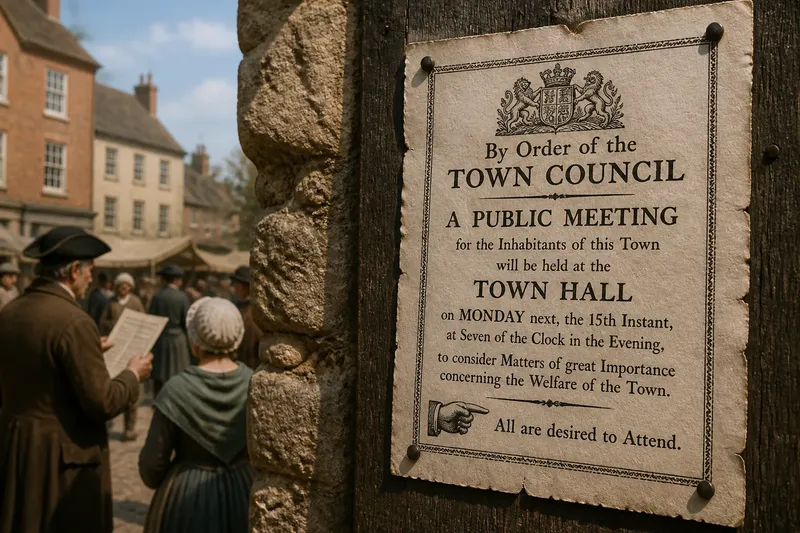
A sheet of paper on a town wall could bring a public announcement within reach of people who had never seen a newspaper. The printed broadside was an early form of public news circulation: a compact notice or report made to be displayed, read aloud, or carried onward. Its strength was reach through reuse, not a full account of events.
What made a broadside easy to circulate?
A broadside was typically a single printed sheet, often designed to be read without opening or unfolding a bound publication. Printers could set a short text in type, print copies, and distribute them to public places or directly to readers. The format suited announcements, proclamations, reports of notable events, and other material that needed to be seen beyond a private letter or a small circle.
Its physical form shaped its purpose. A sheet could be pinned to a door, displayed in a marketplace, handed from person to person, or read aloud to a group. Someone who could not read the text might still hear it from another reader. The paper functioned a little like a noticeboard you could carry: one copy could bring the same wording into several settings.
That portability did not make every broadside reliable or complete. A printed sheet could preserve a claim and circulate it efficiently, but readers still needed to ask who issued it, what information it included, and what might be missing. The format explains how a message traveled; it does not settle whether the message was accurate.
Which kind of broadside served which purpose?
Broadside is a broad format, not one fixed genre. Three common uses show why the same single-sheet form could serve different kinds of public communication.
- Official proclamation: An authority could use a broadside to announce a rule, order, or public decision. This approach suited readers who needed to know what was being declared and by whom. Its formal tone could make the issuing authority clear, while leaving little room for debate or explanation.
- Event report or news sheet: A printer could circulate a compact account of a notable occurrence. This approach suited readers seeking a shareable report about something beyond their immediate community. The limited space encouraged selection: some details made the sheet, while others did not.
- Public notice or appeal: A group or individual could use a broadside to call attention to an announcement, request, or cause. This approach suited people trying to reach passersby or a wider local audience. Its purpose could be persuasive as well as informative, so readers had reason to distinguish the reported facts from the appeal being made.
These uses could overlap. A sheet might report an event while also urging a particular response. A reader should therefore look not only at what the text says, but also at what the issuer wants the audience to do.
What did the format make visible—and leave out?
A broadside’s compactness helped it circulate, but it also imposed limits. A brief sheet could foreground a date, a named authority, a striking event, or a call to action. It had less room for background, competing accounts, qualifications, or a careful explanation of how information had been gathered. If a reader encountered only the sheet, the concise wording might feel like the whole story even when it was only one account.
The display setting mattered too. A sheet posted in a prominent public place could be encountered by many people, but its audience was not necessarily everyone. Access depended on where it was placed, who could read it, which language it used, and whether someone was available to read it aloud. Circulation could widen a message without making access equal.
There was also a difference between seeing a printed claim and knowing its path. A broadside might name an issuer or printer, but it would not always explain who supplied the underlying information. Later readers could copy or repeat its wording without carrying along the circumstances that gave the claim meaning. The sheet’s survival offered evidence that a message circulated, not automatic proof that every detail in it was correct.
How does the broadside compare with other ways to circulate news?
Three approaches clarify the trade-offs. A posted broadside made a message visible in a shared place. A hand-carried sheet let a reader take the message elsewhere. A spoken reading could bring its contents to listeners who did not read the printed language. Each suited a different route into public attention.
- Posting: Best suited to a notice intended for people who regularly passed a particular place. The message stayed available there, but readers needed to encounter that location.
- Handing out or passing along: Best suited to a message meant to travel between people or communities. The paper could move beyond its original display, though each handoff might separate it from its source.
- Reading aloud: Best suited to a group gathered around a reader, including people unable to read the sheet themselves. Listeners gained access through speech, but they depended on the reader’s delivery and could not inspect the wording as easily.
Say a printer produces a fictional notice about a meeting at a local hall. Posted near the hall, it would most directly reach people already in that area; carried to another neighborhood, it could alert a different audience; read aloud at a gathering, it could reach listeners who never handled the paper. The expected observable difference is who encounters the announcement and in what form—not whether the meeting itself is accurately described.
For a reader studying an old broadside, the best comparison depends on the question. To understand how an authority announced a decision, examine the issuer and wording. To understand how a report reached people, consider where the sheet could be displayed, passed, or read aloud. To assess what a surviving copy can tell you, separate evidence of circulation from evidence about the event described.
What should readers ask about a broadside?
Who issued or printed the sheet?
Look for a named authority, organization, printer, or other attribution. That information can clarify who put the message into circulation, though it may not identify the original source of every claim.
What is the sheet asking readers to believe or do?
Separate descriptions of events from commands, appeals, and expressions of opinion. A notice may combine them, and recognizing the difference helps explain its purpose.
Who could encounter it?
Consider its likely display place, language, and whether it could be carried or read aloud. These clues help distinguish an intended audience from the wider public the sheet might never have reached.
What context is absent?
Ask what details would help explain the claim: how information was obtained, what happened before or after, and whether another account is available. A short sheet often leaves those questions open.
How should we choose among these routes?
Choose the route that fits the communication goal. Posting suits a message tied to a place; passing a sheet suits movement between readers; reading aloud suits a group that can gather around a speaker. For historical interpretation, choose the route that best answers your question about audience, authority, or circulation rather than treating all three as interchangeable.
The phrase “printed broadside” is useful because it points to both an object and a method: a compact sheet designed to put words into public circulation. When you encounter one, trace the path it could take before treating its message as settled. Ask who printed it, where it might have appeared, who could pass it on, and what a reader would still need to know. That distinction—between a message traveling widely and a claim being fully established—remains useful whenever public news arrives in a small, easily shared form.