Reading a Developing Story Before You Share It
Reading a developing story carefully helps you share what is confirmed, leave open questions open, and return to the original source as details change.
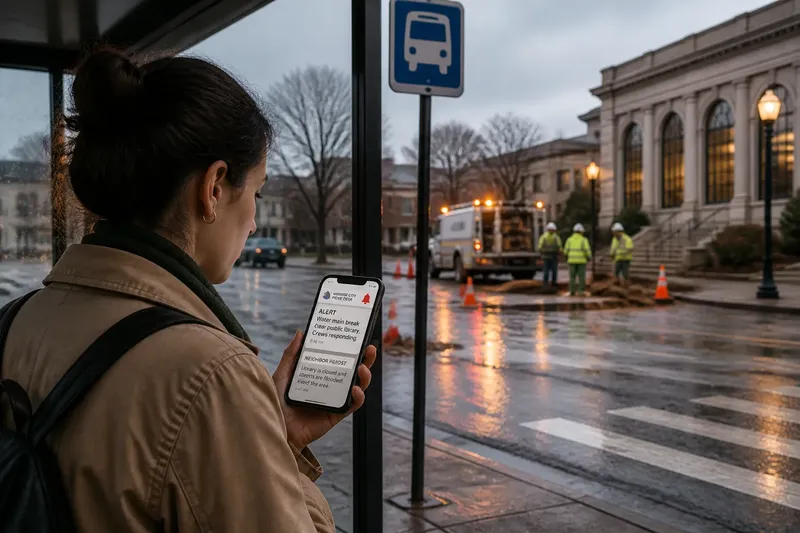
Your phone lights up while you are waiting for the bus: a local alert says a water main has broken near the public library, and a social post claims the library is closed. Reading a developing story before you share it means pausing over what the report actually confirms, what remains unclear, and when the information was last updated. That small pause can keep an early account from becoming a confident but unsupported claim.
Imagine that the alert comes from the fictional Harbor City News Desk. Its first post says crews are responding to a water-main break near the library. A neighbor’s repost adds that the library is closed and the nearby streets are flooded. The desk has not said either of those things. This invented situation offers a useful way to follow an unfolding report from its first notice to a more settled account.
What does the first alert actually establish?
Read the alert itself before reacting to the repost. The wording establishes only that the news desk is reporting a water-main break near the library and that crews are responding. It does not establish the exact location, the scale of the disruption, the cause, or whether the building is open.
That distinction can feel overly cautious when a post is moving quickly. It is not. Early information is often partial because reporters and public agencies are still checking what happened. A short alert may accurately describe what is known at that moment while leaving important questions unanswered.
Separate the post into three mental columns:
- Confirmed in the report: the claims the source directly states, such as a reported break and a response by crews.
- Open questions: details the report does not settle, such as the affected streets or the library’s status.
- Added claims: details appearing in replies or reposts but not in the source you have checked.
This is not a verdict that added claims are false. It is a way to avoid treating them as confirmed before you know where they came from. A claim can be plausible and still be unverified.
Why does the timestamp matter?
Look for the time attached to the original report and, if available, the time of its latest update. A timestamp tells you when the account was published or revised; it does not automatically tell you that every detail is current. Check whether the post is marked as updated and whether the new wording actually addresses the question you care about.
Suppose the Harbor City desk adds a note later saying crews have isolated the break. That update may change the picture of the response, but it still says nothing about whether the library has closed. A repost of the first alert can continue circulating after the original changes, just as an old note on a refrigerator can stay visible after someone has replaced the plan.
When the timing is unclear, avoid turning a report into a present-tense claim. “The desk reported a break near the library earlier” is more faithful than “The library is closed now” if closure has not been confirmed. Keep the time marker close to the claim, rather than relying on readers to infer it from a screenshot.
How can you tell what is confirmed and what is still open?
Pay attention to the source’s verbs and qualifications. “Crews are responding” reports an action. “Officials are assessing the affected area” signals that the scope is still being determined. “The cause is under investigation” leaves the cause open. None of these phrases licenses a reader to supply a more complete explanation.
In the invented Harbor City report, the desk later quotes a utility spokesperson saying that crews isolated the break and were checking nearby buildings. That adds two reported details: isolation of the break and building checks. It does not establish that water entered the library, that streets are flooded, or that service has returned. Each new sentence should be read for the specific question it answers, not as a general upgrade to the entire story.
A useful test is to ask, “Who says this, and what exactly do they say?” If the answer is only “people online,” the claim remains unattributed. If the source names a utility spokesperson, the attribution helps you judge the claim’s origin, but it does not make every related rumor part of that statement.
Should you share the alert while details are changing?
Share only if the alert itself is useful to your audience, and keep your wording within its boundaries. You might send the original link with a short note that the news desk reports crews responding near the library, while its post does not confirm a closure. That gives recipients both the information and its limit.
If the message could affect someone’s immediate plans, direct them to the relevant original source rather than summarizing a string of reposts. For the invented case, that might mean sharing the Harbor City desk’s post and the utility’s public notice, if one is available. Do not attach an unverified closure claim simply because it seems helpful; a wrong practical detail can send someone on an unnecessary detour.
Sometimes the best choice is not to share yet. If a post offers no source, has no clear date, or uses an old screenshot with no route back to the original, waiting costs little and avoids lending authority to an unclear account. If you do share, preserve the source’s uncertainty instead of smoothing it away.
What should you do when a report changes?
Return to the original source instead of relying on a copied snippet. Check the post, article, or official notice for an update, correction, or added context. A later report may resolve one open question while leaving another unsettled, so read the new material rather than assuming that “updated” means every detail has been confirmed.
Imagine that Harbor City News Desk later reports that the library stayed open, while the utility says crews are still checking a nearby building. The closure claim in the neighbor’s repost is now contradicted by the desk’s account, but the utility’s continuing work remains part of the story. If you passed along the earlier rumor, correct it plainly and link to the newer report. Do not quietly delete the message if people may still be relying on it.
When sources differ, identify the difference without forcing a resolution. One source may be discussing the library building; another may be referring to a nearby street or service area. If the reports do not clarify the distinction, say that the accounts differ and leave the question open. A neat answer is not more accurate merely because it is easier to share.
Which questions help with a developing story?
What does “developing story” mean?
It is a report that is still being updated as information arrives and is checked. The label signals that details may change; it does not tell you which claims are settled or how complete the account is.
Is a newer post always more reliable?
Not necessarily. A newer post may contain a correction or a useful update, but its claims still need a clear source and careful wording. Compare what it adds with the earlier account rather than treating recency as proof.
How should I handle an unanswered question?
Keep it unanswered in your own account. You can say that the source has not confirmed the library’s status, for example, and return to the source later if that detail matters.
What if I already shared an unsupported detail?
Post a direct correction where people who saw the original message can find it, and include the source that changed or clarified the account. State what was unsupported without blaming readers who passed it along.
What does the Harbor City case teach?
The fictional sequence began with a narrow alert, grew through a repost that added claims, and became clearer as the original desk and utility published more information. Its practical lesson is not to distrust every early report. It is to keep the reach of each claim matched to the evidence available at that moment.
Before sharing a developing story, check the timestamp, identify the original source, separate stated facts from open questions, and revisit the source when the account changes. In the Harbor City example, those habits let a reader pass along the response information without inventing a closure or flooding. Reading a developing story this way makes uncertainty visible, so readers can act on what is known without mistaking a gap for an answer.